

Call: +34 876 553 510
Email: andre.marques.souza@gmail.com
Address: c/Pedro Cerbuna 12, Universidad de Zaragoza, Facultad de Ciencias, Departamento de Química Analítica – Zaragoza (Spain)
ABOUT ME
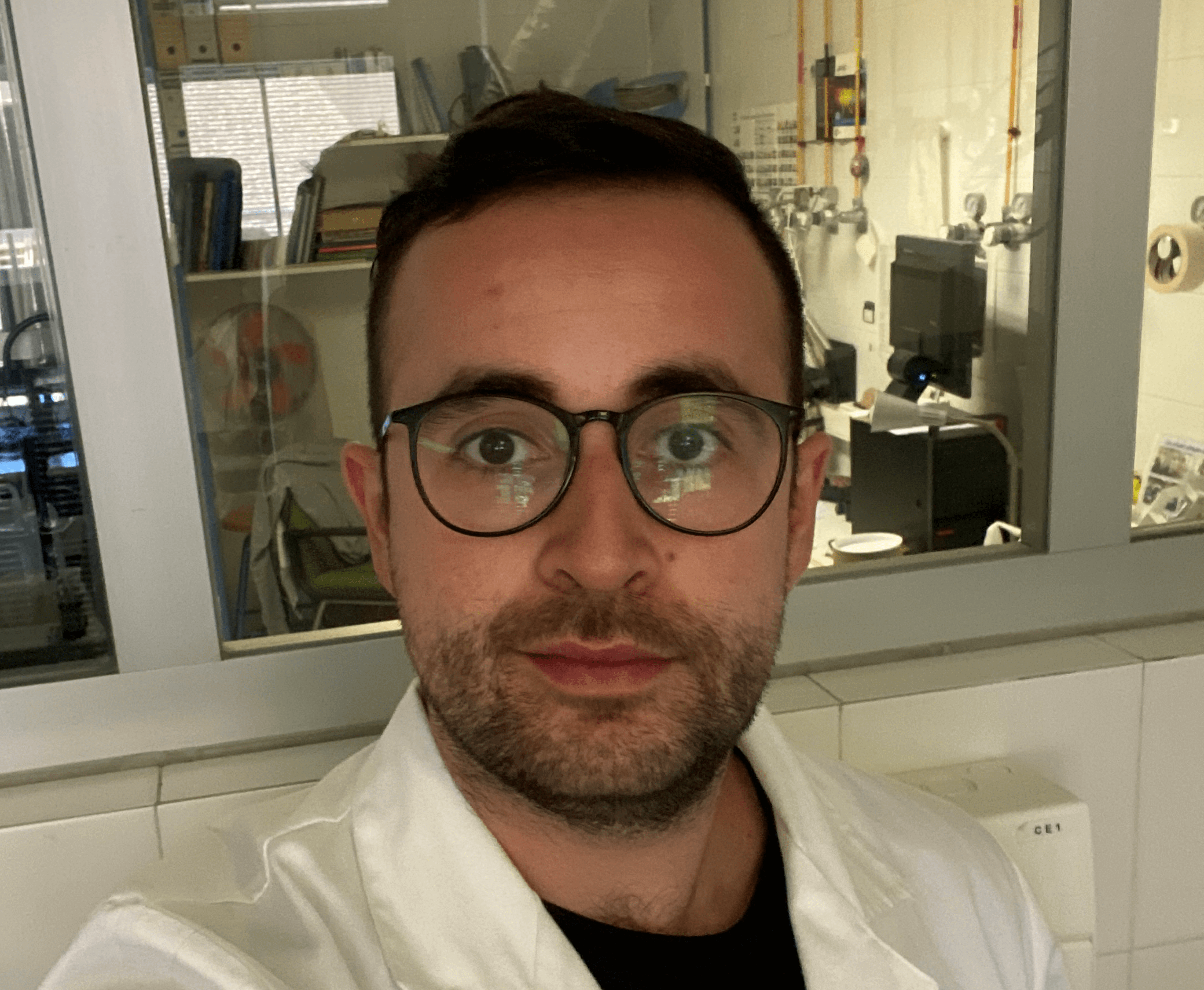
André Marques – Bsc in Chemistry (USP, Brazil), Master in Chemical Science and Technology (UFABC, Brazil) – is currently a PhD Candidate at Analytical Science in Chemistry program, MARTE Group. His thesis is focused on development of direct analysis of solid samples by Atomic Absorption Spectroscopy, also exploring Molecular Absorption and its possibilities.
PUBLICATIONS
2026
Souza, André L. M.; Aramendía, Maite; García-Ruiz, Esperanza; Nakadi, Flávio V.; Resano, Javier; Resano, Martín
En: J. Anal. At. Spectrom., vol. 41, pp. 1951-1963, 2026.
@article{D6JA00062B,

title = {Single- and dual-isotopic analysis using high-resolution continuum-source graphite-furnace molecular absorption. Strategies for data selection, processing, and modeling},

author = {André L. M. Souza and Maite Aramendía and Esperanza García-Ruiz and Flávio V. Nakadi and Javier Resano and Martín Resano},

url = {http://dx.doi.org/10.1039/D6JA00062B},

doi = {10.1039/D6JA00062B},

year  = {2026},

date = {2026-01-01},

urldate = {2026-01-01},

journal = {J. Anal. At. Spectrom.},

volume = {41},

pages = {1951-1963},

publisher = {The Royal Society of Chemistry},

abstract = {This work evaluates different strategies for data processing, aiming at achieving isotopic information via high-resolution continuum-source graphite-furnace molecular absorption. For this purpose, two different molecules are investigated: CaF and CaCl. In the first case, only the measurement of 44Ca and 40Ca is pursued, whereas in the second case, isotopic variations affect both elements present in the molecule (44Ca and 40Ca, but also 37Cl and 35Cl). Thus, two different approaches are proposed. For Ca isotopic analysis through the monitoring of CaF, the effects of selecting the number of detection pixels and the number of molecular spectra, as well as of using a regression approach for temporal data, are discussed. Overall, using three detector pixels and using this regression approach tend to produce the best results (0.5–1.0% RSD) for isotopic analysis via HR CS GFMAS in those situations in which the signal can be derived from two separate peaks. On the other hand, to perform simultaneous Ca and Cl isotopic analysis by monitoring CaCl, a machine-learning strategy is proposed. The performance of such a model is promising for isotopic abundances of at least 10% (median absolute percentage error of 1.21%), while the error escalates when one of the isotopes shows a lower abundance. To detect such underperforming situations in real-world settings, it is recommended to monitor the prediction uncertainty to set thresholds and flag results with poor reliability.},

keywords = {},

pubstate = {published},

tppubtype = {article}

}
2024
Aramendía, Maite; Souza, André L. M.; Nakadi, Flávio V.; Resano, Martín
En: J. Anal. At. Spectrom., vol. 39, pp. 767-779, 2024.
@article{D3JA00420A,

title = {Boron elemental and isotopic determination via the BF diatomic molecule using high-resolution continuum source graphite furnace molecular absorption spectrometry},

author = {Maite Aramendía and André L. M. Souza and Flávio V. Nakadi and Martín Resano},

url = {http://dx.doi.org/10.1039/D3JA00420A},

doi = {10.1039/D3JA00420A},

year  = {2024},

date = {2024-01-01},

urldate = {2024-01-01},

journal = {J. Anal. At. Spectrom.},

volume = {39},

pages = {767-779},

publisher = {The Royal Society of Chemistry},

abstract = {Boron trace determination in biological materials is needed in different fields of application. Direct B determination by means of Graphite Furnace Atomic Absorption Spectrometry (SS-GFAAS) has been used in the past for this purpose, offering good detection limits hardly achievable by other techniques. However, such methods require the use of high atomization temperatures combined with large integration times to promote B atomization, which dramatically reduces the lifetime of the instrument's graphite parts. In this work, a new perspective for B determination by means of Graphite Furnace Molecular Absorption Spectrometry (GFMAS) is proposed. B was detected as the diatomic molecule BF (boron monofluoride), deploying a gas phase reaction with CH3F as fluorinating agent. Based on this strategy, a method for the direct determination of B in two biological certified reference materials (NIST SRM 1570a spinach leaves and NIST SRM 1573a tomato leaves) has been developed, providing similar detection capabilities to the GFAAS method (LOD of 0.24 ng) but requiring much milder furnace conditions. Moreover, the appearance of memory effects, very common in GFAAS methods, is also avoided with this method. Straightforward calibration with aqueous standard solutions was also found to be possible. To this end, a mixture of W (permanent), citric acid, and Ca as chemical modifiers was found to be essential for obtaining a reproducible and sufficiently sensitive signal for boron solutions, comparable to the signals obtained for the solid samples. With this method, accurate results were obtained for the direct analysis of both certified reference materials, provided that spectral interferences from the PO molecule were properly corrected. Precision values in the range of 15% RSD, as typically reported for direct solid sampling GFAAS, were found. Finally, and as an additional advantage of the GFMAS method, a large isotopic shift in the absorbance of the 10BF and 11BF molecules can be accurately monitored at a secondary transition for the BF molecule. This offers novel analytical possibilities for the method, which are also explored in this study. In this regard, control of the B concentration was found to be critical for obtaining accurate and precise isotope ratios for this element.},

keywords = {},

pubstate = {published},

tppubtype = {article}

}